Wednesday, 22 August 2012

Perfect Planters

When I started a vegetable garden on my London balcony, planters and containers were an absolute godsend – on a concrete balcony, one simply HAS to have a good selection of planters and containers. Now that I have made the transition from London balcony to Peak District garden however, this does not mean that I no longer have any need for containers – far from it!
Planning a garden is an enjoyable experience. And containers really add a degree of flexibility, style and ease of use. Here’s a rundown of why I love using containers in the London Vegetable Garden.
Flexibility
From month to month (and even week to week in the peak summer season), plants take on a life of their own. A few neatly arranged pots can quickly become an amalgamated mass of unruly plants, whilst those suddenly flowering can clash with their surrounding neighbours. Containers and planters allow the gardener to move plants around with no interference to roots, allowing you to rearrange your garden and keep it interesting all summer, and year, round.
Style
Say ‘container’ or ‘planter’, and many people instantly start thinking about cheap plastic containers obtained cheaply from garden centres or pound shops. But there exists a whole wealth of planters and containers that are stylish, beautifully made and really add an ambiance to the garden in their own right. Depending on style, a well-planted container can completely transform the look of the garden. Some of my favourite planters and containers can be found here. As shown from the pictures below, planters and containers come in all styles, shapes and sizes and can fit into any garden, adding class, style and make excellent features.


Garden rescue!
Like much of the UK, my garden has spent most of this summer under a blanket of dark grey cloud and rain. But the plants I have in containers have been salvaged due to their portability. As overhanging trees and bushes have grown, blocking out natural light, I have been able to move those plants in containers to new, sunny positions, rescuing tired tomatoes and miffed marigolds. Containers allow you to shift plants around according to the season, keeping plants in the best possible position for them to flourish.
In summary, planters and containers are a wonderful asset to the gardener, whether in a sprawling country garden, or on a small urban balcony. Combined with the right plants or flowers, a planter’s visual aesthetic can produce a stunning effect, adding colour, style and architectural lines to any garden.
Have any of you experimented with planters or containers? If so, we’d love to see your examples. Feel free to upload your photos on our Facebook page. For a great selection of timeless, classic planters and containers for your garden, I recommend the product range available at Garden Trading.

Thursday, 9 August 2012

Growing Your Own – Getting Started


Growing your own is one of the most fashionable and rewarding activities that has swarmed the UK and it doesn’t matter if you have a large garden or just a balcony. There is a lot that you can cultivate in a few containers and below you will find advice on what pots you can grow in and the compost that is required to ensure that you always harvest healthy yields. 

Growing your own fruit and vegetables that are packed with vitamins and minerals will not only be well received by your body, but also that of your family. Having a supply of vegetables in containers allows you to eat fresh and enjoy a variety of flavours.

So what containers will I need?

It all depends on the yields you wish to cultivate. If salad leaves are at the top of your priority list, these plants can be grown in quite shallow containers. A 17cm deep and 30cm long container would suffice, but we would recommend that you have a trough that is measured 20cm wide, 60cm long and at least 17cm deep. 

The amount of containers that you would need also depends on the succession of crops you wish to obtain. For example, if you have two troughs you can grow two rows in one and then a couple of weeks later another two rows, ensuring that you’re never short of lettuce leaves over the course of the summer.

Where do I place my containers?

We recommend that you place your containers close to home as you will be more likely to use them and also for convenience.

How often do I need to water them?

A general rule of thumb is that the larger the container, the less often you will need to water. An even and uninterrupted water supply is one of the keys to growing you own veg.


What compost should I use when growing veg in containers?

The growing medium that you need to use can depend slightly on the size of your container, but if you’re not a perfectionist, this wouldn’t really matter. For smaller containers that will become the home for your lettuce and carrots for example, the cheapest compost you can find will suffice. 

For large containers or raised beds, a good multi-purpose compost or a loam-based compost will work wonders. However, please do be aware that these containers can take a lot to fill so to keep your container garden cost effective it may be best to bulk buy or use top soil.

Planning to become self sufficient is a big step and these are some of the first steps to take when growing vegetables successfully. From this point on all you need to do is plant up and ensure you follow the instructions that are on the back of the seed packs. 

Mr McGregor is a popular writer for Notcutts, a specialist garden centre who also enjoy meeting and lending a helping hand to their customers. For more tips on how to get started with growing your own have a look at their Garden Library and blog.

Thursday, 24 May 2012

Growing Flowers From Seed: Companion Planting

Growing vegetables affords the gardener a myriad range of beautiful sights, with plants consisting of a different shapes, sizes, textures, form and colour.  However, combine these plants with flowers and you have a quintessential English garden.

Along with vegetables, I'm also growing a range of flowers this year.  I enjoy the challenge of gardening from seed and the huge sense of achievement that it brings.  The commitment and dedication to nurture plants and flowers from seeds is great; thus so is the reward.

As well as the colour and beauty that flowers bring to the garden, they can also be fantastic for the vegetable grower!  Companion planting is an age-old technique employed by gardeners as an organic alternative to chemical pest deterrents.

I'm growing French marigolds because I like them, but also because they are the perfect companion plant for tomatoes, which I am also growing.  Tomato plants are highly susceptible to whitefly, which can damage a whole crop.  However, whitefly detest French marigolds and thus avoid them like the plague!  Not only do the marigolds keep whitefly at bay; they also make the garden look very pretty!
In addition to marigolds, I'm also growing a range of flowers from seed as a challenge, to add colour to the garden in summer and also so that my wife can have a nice supply of flowers for the house.  I am growing the following from seed:

Malva
Sweet Pea
Morning Glory
Convolvulus
As always, progress will be documented here on the London Vegetable Garden blog, as well as over on Twitter and our Facebook page!

Tuesday, 22 May 2012

Book Review: 'Kitchen Garden Estate', National Trust, £15


For several years now, the grow your own movement has continued to gain substantial sway, with people seeking a return to wholesome, natural and sustainable food production, as well as a simpler way of life.

There are many relevant gardening books available to the amateur gardener, but it can often be difficult to find the right book, whether you're looking for practical advice or are simply eager to find out more about techniques and the cultural history of gardening and food production.

The National Trust has recently released a fantastic new book entitled 'Kitchen Garden Estate' by Helene Gammack, in which traditional country-house techniques for the modern gardener or smallholder are explored.  And they kindly sent me a copy to have a look at.

I'm a huge advocate of the National Trust and in typical fashion, this book is of an extremely high standard, exploring a range of gardening techniques employed by country estates prior to the industrial revolution, when of course large estates had to be self-sufficient and provide all of their own produce, from meat and game to fruit, vegetables, milk and much more besides.

Whilst the average reader (myself included) is not likely to have an orchard, vineyard, lakes and dairy cattle, the techniques used in days of old are fascinating and absorbing to read about.  As one would expect from a National Trust book, the tome is littered with beautiful pictures, historical illustrations and diagrams, ensuring that time-honoured gardening techniques are clearly explained and made relevant to the modern-day gardener.

The first few chapters really explore the history of fruit and vegetables, sharing advice, recipes and tips that have been passed down over hundreds of years and these first few chapters really do offer practical advice, from companion planting guides to salad garden layouts.

In summary, Kitchen Garden Estate is a wonderful and absorbing book, combining the perfect mix of practical advice, historical intrigue and beautiful pictures.  The book is available to purchase directly from the National Trust website for a very acceptable price of £15 and makes a wonderful addition to your garden book collection, or a perfect present.

Monday, 21 May 2012

HOW TO: Grow Peas In 2 Feet Of Space

Space: the final frontier!  For many urban gardeners, especially those living in flats with balconies, the lack of soil and space means that gardening attempts are limited to crops in pots and containers.  But this is not limiting at all.

Many vegetable plants don't require a large mass of space: some simply like a deep pot; others are quite at home in grow-bags and others can simply be grown in, well, anything!

Although I have a garden, actual soil space is very limited, so during this summer's London Vegetable Garden growing escapades, I'm planning to show you all what can be achieved in small spaces using bags, pots and various containers.

In the first of these 'space-saving' series, I'm looking at peas.  There's nothing nicer than home-grown peas, plucked fresh from the pod and eaten raw, or boiled up with some mint and served alongside new potatoes and a lamb chop.  So this week, I'm showing you how you can grow peas on a balcony or on a small patio.

Firstly, you'll need to grow your peas.  If, like me, you enjoy growing from seed, simply knock up a few newspaper plant pots (click here for my guide on how to make these) and plant your peas.  They grow quickly and within a couple of weeks, you should have some visible shoots, like so:
After about 5 weeks, your pea plants should be ready for planting out, when they look something like this:
Now, here's for the space-saving bit.  Peas like a little bit of depth for their roots, whilst the plants are climbers, meaning that they grow upwards.  In terms of space, you'll only need a couple of square feet of space and about 5 feet of height to grow your peas – which on a balcony or patio, is more than achievable. 

Remember the newspaper pots?  You can plant these straight into the soil, where the newspaper will disintegrate quickly, ensuring no root damage to the plants.  I've unwrapped one just to show you how strong the roots are – here they have grown right through the newspaper, so don't worry about planting the whole thing!
I'm planting my peas in a hessian sack, which was £6.99 from the local garden centre.  It comes with internal supports for the canes, which is a really useful feature, although you can use a deep flowerpot and tape cane supports to the side using duct tape – it will work just as well.
I've filled with a mixture of soil, multi-purpose compost and my Miracle-Gro enriched, expandable compost (see the review here) to ensure a balanced and nourished soil for the peas, since they will be growing in this same soil all summer.  The canes have been fastened at the top and provide some support for the pea plants as they grow – they'll soon latch on and make their way to the top.
So there we have it: easy peasy!  If you have a balcony, patio, or tiny outdoor area, you really can grow some peas following these instructions – it's that simple.  And due to the quick growth of pea plants, it's not too late to start growing your peas, from scratch, now!  Good luck!

Sunday, 20 May 2012

HOW TO: Teabag Box Flowerpots

When I had an allotment, one of the things that really struck me was how much recycling, re-purposing and general 'make do and mend' was going on amongst my fellow allotment growers.  All gardeners have a knack for making use of ordinary objects to help them out in the garden and down the allotment.

You may recall my blog post showing you how to make newspaper plant pots – a great way to create loads of environmentally-friendly flower pots at no cost, that can be planted directly into the ground and thus avoiding root disturbance.

However, the savvy gardener really can make use of anything.  When starting another batch of pea seeds off, I needed a container but had run out of pots and newspaper.  Undeterred, I looked in the recycling bin and found an old teabag box and set about re-purposing it.  Here's how I did it.

First, take the lid off, since this is not needed.  

Ensure that you pierce a few holes in the bottom, using an old pencil to pierce the box a few times.  This ensures some drainage.

Fill with compost, plant your seeds and Bob's your uncle!

As you can see, this makes an effective pot that is as good as any flowerpot.  Why not have a go yourself?
So, what have you thrifty lot managed to re-purpose?  I'd really love to see what odds and ends are helping you out with your vegetable growing and gardening.  Please tweet me your photos to @londonveggarden or come and post your photos on our Facebook page wall!  Thanks!

Weekend Round-Up: Planting Out

Yesterday morning, I rather hastily rattled off a blog post bemoaning the English weather (especially the Peak District weather) and the fact that my planned weekend of planting out was waylaid by damp weather.

However, in typically British style, the weather perked up and I was able to get into the garden and start planting out the very first vegetables of the London Vegetable Garden this year!  I had been especially keen to get this job done this weekend, since we are supposed to have some very warm weather this week – surely a perfect time to get vegetable plants outside and settled down into the outdoor climes.

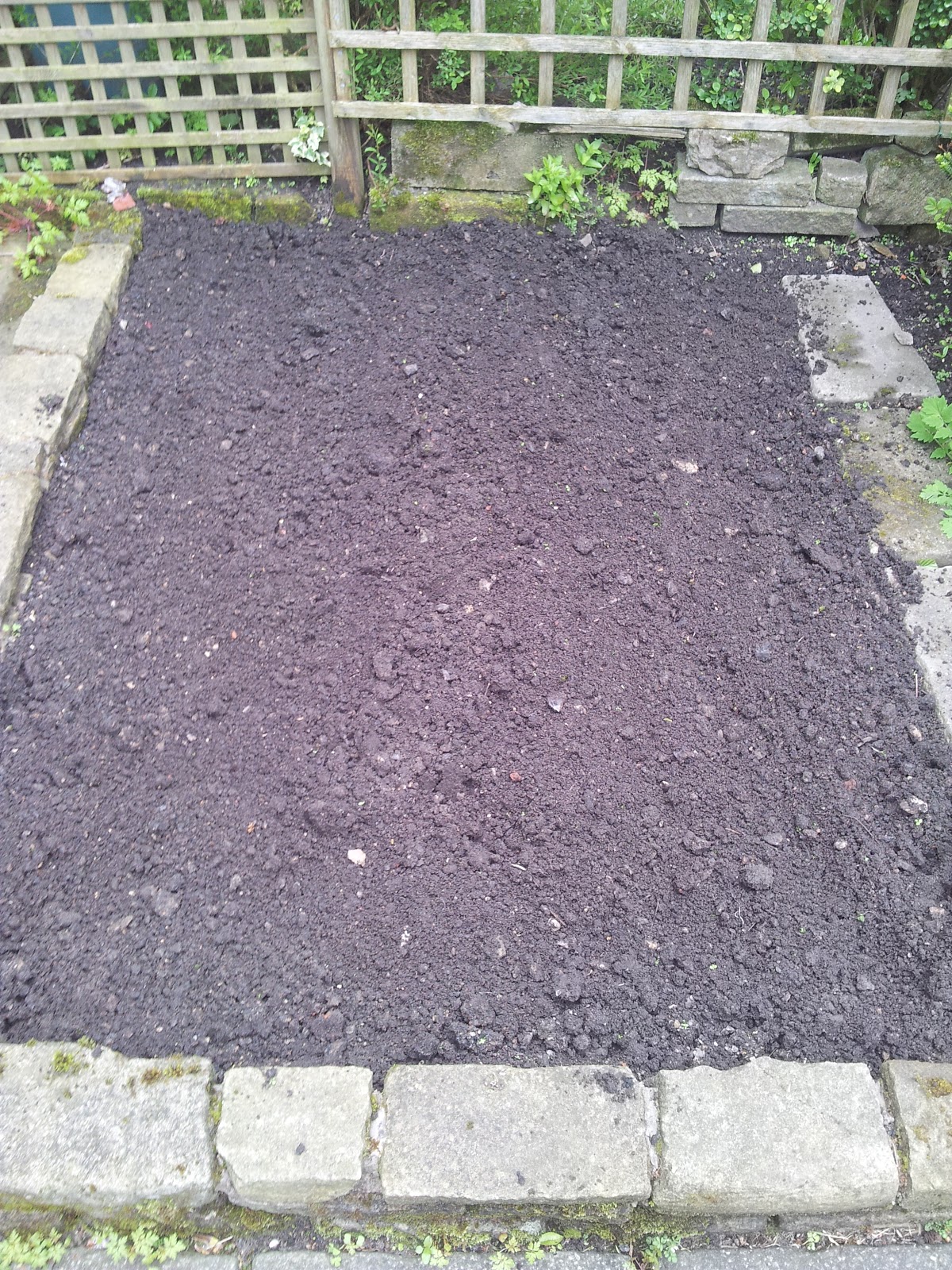
The first job I needed to tackle ('tackle' being the operative word) was weeding the vegetable patch.  As noted in previous blog posts, I only have a space about 4' x 5' in which to plant my vegetables directly into the soil: the rest of the plants need to be creatively distributed in pots, grow-bags and containers.  Anyway, I set to work weeding, as illustrated by a before and after set:


With the ground prepared, I then proceeded to set up my cane supports for the runner beans.  Initially, I had planned to place the runner beans along the right-hand-side of the plot; but realised that this would block a lot of the sunlight to the left of the vegetable patch.  And this position does not get a great deal of sunlight as it is.


As noted in previous blog posts, I have conducted staggered seed planting this year, so the purpose of the day was to get a couple of the early vegetable plants planted out and then to see how they fare.  If all is a disaster due to weather or pests, I have a reserve army of runner bean plants ready and waiting!
I dug a good hole around each cane support and mixed in some of my Miracle-Gro enriched compost.  This compost has a lot of nutrients and plant food contained within it and considering the stony, dry nature of the soil I was planting into, I wanted to give my runner beans a bit of nourishment as I planted them out – hopefully this will help them to settle into their new surroundings.


Following this, I also planted out a few of my courgette plants.  My early courgette plants have really started growing at quite a speed this week, helped in no small part by the warm temperature of the mini greenhouse.  Their size meant that it was now time to get them into the ground and onto the next stage of their lives. 


I feel that I could have planted the courgette plants a little more spaced out, but space is a premium and the plants are still relatively small.  We'll see how they get on growing over the next few weeks.  Needless to say, if all of them flourish and they actually do need more space, then we can simply sacrifice one of the plants to accommodate that.

So there we have it – the first veritable 'plants' of this year's London Vegetable Garden project!  It's always a worrying time for the gardener: will the plants take in their new soil?  How many problems will birds and slugs cause me?  Will excessive rain or a sudden heatwave damage the plants?  Who knows.  But for now, we are out of the house and into the garden.

Onwards and upwards!

I also planted some peas this weekend, using a sack, some canes and only 2 feet of patio space.  Next week I'll be showing you all how you can grow peas on a tiny balcony or on your city patio.  Remember to bookmark the London Vegetable Garden, or get alerted to brand new articles by following me on Twitter @londonveggarden or by liking us on Facebook. 

LinkWithin

Related Posts with Thumbnails