Wednesday, 1 May 2013

HOW TO: Look After Young Vegetable Seedlings


Whilst a garden, patio or balcony full of vegetable plants requires a committed level of care and attention, I actually think that vegetable seedlings are perhaps more needy.

Regardless of where I've gardened – the Hackney balcony (spiritual home of the London Vegetable Garden), Surrey allotment or Peak District cottage garden – I've always grown my vegetable seeds in pots and trays on windowsills, due to the absence of a greenhouse (you can read more about growing vegetable plants on a windowsill here).  And in my opinion, whether for the amateur urban gardener or the seasoned veteran alike, this is now when the serious care and attention begins. 

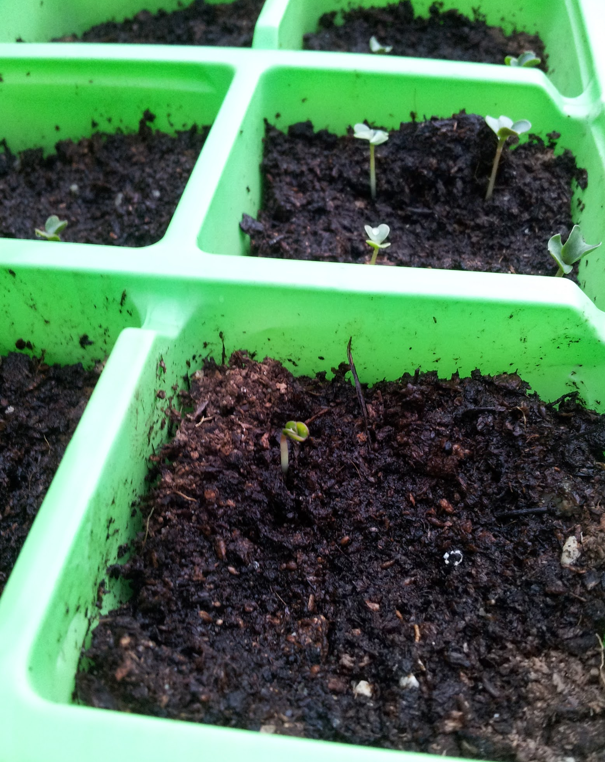
I planted 2013's vegetable seeds last weekend, but have not watered them every night; in fact I have only watered them a couple of times since sowing, but then it has not been overly hot up here in the Peak District!  Now these vegetable seeds have grown into vegetable seedlings however (see last weekend's blog post), much due care and diligence is required.  Here is my tip to ensuring that my cauliflower and cabbage seedlings will thrive and grow into sturdy vegetable plants.

i) Do monitor your vegetable seedlings daily

Depending on your growing conditions, your vegetable seeds may not need watering every single day.  However, it's essential that you check!  As I have previously said, I have not checked my plants and pots every day; but now they are seedlings, they are highly vulnerable.  Simply check them each day and make sure the soil is damp enough that the seedlings have enough water to drink.

ii) Don't roast your vegetable seedlings

One of the factors that can lead to dry, parched vegetable seedlings is, unsurprisingly, heat!  Whilst it is important for young plants to receive enough warmth, it's essential that they are not left to dry out.  If you are growing your vegetable seeds in a greenhouse, ensure ventilation and check daily to ensure that the greenhouse has not acted as an oven.  Alternatively, if, like me, you are growing your vegetable seeds by a windowsill, ensure that they are not being baked alive!

iii) Do thin out

'Thinning' is something that happened to my hair when I was 21 and rapidly went bald!  But thinning out is also the practice of stripping away weak seedlings to give the strong ones a better chance.  In many of my trays and pots, I have planted a few seeds, to compensate for the few that won't germinate.  However, seedlings are all about the roots – and when seedlings are in cells in trays, or small pots, they will compete with other seedlings for root space.  If you have one or two really strong seedlings, 'thin' them out by pulling up any other ones and thus creating more root room for the strong seedlings.

I hope that these three tips bode you well for your horticultural adventures – good luck!

And remember, I'd love to hear how all of you are getting on – feel free to share pictures, chat with other gardeners or simply come along and 'like' us on our Facebook page, or come and have a gardening chat with me on Twitter, @londonveggarden.  Happy vegetable gardening!

Greenhouses: Not Just Cold Steel!


When one typically thinks of greenhouses, images of steel frames and cracked glass comes to mind: in essence, something that is sparse and cold: the exact opposite of what a greenhouse does!  But greenhouses don’t have to be a cold, steel construction: Gabriel Ash stocks a wonderful range of high-quality wooden greenhouses, including a range endorsed by the RHS itself.

So why choose a wooden greenhouse over a steel one?  One of the first benefits is the aesthetic value.  When designing a garden space to be aesthetically pleasing, matching a timeless wooden shed with a similar greenhouse makes a substantial difference, as indicated here in the wonderful Rosemoor combi from Gabriel Ash:


Instantly, this transforms the garden ‘shed’ and ‘greenhouse’ into a pretty outdoors building that can be utilised in many more ways.  What better way to entertain friends in the summer, than by sitting in the pleasing warmth of an outdoor, organic conservatory, filled with the heady and aromatic smell of warm tomatoes?  Or sitting down to read the newspaper?  Beautifully-designed products such as these can offer the amateur gardener so much more than simply ‘a greenhouse’ or ‘a shed’.

Another beautiful example is the RHS Grand Vinehouse, available at Gabriel Ash, providing a substantial outdoor space for those fortunate enough to have a lot more space to play with!  This impressive wooden greenhouse offers the gardener a truly substantial space not only to garden, but to relax, enjoy a cup of tea and chat with friends.


So if you’re looking for a greenhouse in your garden (something that is much-needed in this cold British weather!), why not consider something different from the usual steel and glass – bring some warmth to your garden in more ways than one, with a beautifully-made wooden greenhouse from Gabriel Ash.


Monday, 29 April 2013

Cabin Fever!


Last week, I was chatting about garden sheds, which you can read more about by clicking here.  Bitten by the ‘outdoor building’ bug and also somewhat inspired by Kevin McCloud’s cabin in the woods in his ‘Man-Made Home’ programme, I’ve been taking a look at log cabins.

Log cabins have long conjured up images of rural retreats; calm buildings for getting away from it all.  However, you don’t need to escape into the woods to retreat into a beautiful wooden oasis.

With more and more people opting for a work-life balance, working from home or setting up your own business is becoming more prevalent; yet fitting an existing office space into your home can be difficult.  However, log cabins are being increasingly used for home offices! 

My friend works from home and the log cabin at the bottom of his garden is not only an office, but a quiet retreat from the hum and din of everyday life that carries on only a few metres away!  This Greenacre Home Office is a great example of the sort of log cabin that can be used as an office.

Conversely, log cabins can also be a place where work, and indeed, the stressed and strains of modern life, are left far behind.  I love the thought of this ‘zen log cabin’, which also provides a sheltered outdoor area – perfect to plant some pots of flowers or even train those vegetables!


If you’ve been considering making more use of your garden space and feel like something bigger and more homely than a shed, a log cabin can not only provide you with a space that’s unique, comforting and natural, but can also, in effect, add another room to your home.

Take a look at the full range of log cabins available from Waltons. 

Sunday, 28 April 2013

Sprouting Seedlings: Something Special!


Whilst gardening as a pastime is its own reward – a timeless, peaceful and enjoyable communion with nature – there are many different 'thrills' that the modern gardener encounters throughout the year; and none as special as seeing seeds sprout for the first time.

Last weekend was very much about laying the groundwork for the summer ahead – literally.  Having cleared the garden and sorted out the shed, I spent a long afternoon in the shed potting up flowers and planting various vegetable seeds (you can read last weekend's post by clicking here).

However, this weekend I have experienced my first genuine 'agricultural thrill' of 2013, when I noticed that my cauliflower and cabbage seedlings had sprouted!  You may recall that in last weekend's post, I had noted that I had never previously attempted to grow these two vegetables before, so this sprouting was made all the more exciting.

In my five years of experience, I have found that, for the urban gardener, germinating seeds is often one of the most challenging of tasks.  Vegetable seedlings are often very delicate, and compost in small pots and trays is liable to dry out quickly: yet at the same time, it's also easy to over-water them.  So it is always a small victory to see young vegetable seeds pushing up through the compost and into the world; their green shoots contrasting with the black soil you have been staring at for days when watering your pots and trays.

Cabbage Vegetable Seedlings

I also feel that there is a genuine connection between gardener and plant.  Whilst I'm not adverse to buying in plants, flowers, shrubs and so forth, I feel very differently when it comes to vegetables and flowers that I have grown from seed.  There is such a personal connection with that plant; such a passion, borne out of diligence and care, right from the very beginning of that plant's life.  I have carefully potted up a flower pot or tray; I have carefully opened the seed packet and covered the seeds with a bed of compost.  I have placed those trays and pots in a warm, light place; watered them; checked on them.  It's a very personal thing.

 Cauliflower Vegetable Seedlings

So for me, this weekend's progress is a special moment, experienced once every year.  And this is a feeling that anyone can experience, regardless of space or experience.  I'm hoping to plant my vegetables out in the garden of my Peak District cottage this year; but will be growing plenty of these young vegetable plants in containers, pots and windowsills, to demonstrate that no matter who you are or where you live, YOU CAN GROW YOUR OWN! 

It's a wonderful feeling to see seeds that you have nurtured grow into thriving plants that bear wonderful vegetables from the garden: and I sincerely hope that my blog posts can help you to capture this feeling and inspire you to have a go!

Look out for Wednesday's post, in which I'll take you through my do's and don'ts for vegetable seedlings!  In the meantime, feel free to drop by and have a chat with me on Twitter, @londonveggarden.

Thursday, 25 April 2013

London Vegetable Garden Guide to Sheds


If an Englishman’s home is his castle, then what does that make his shed?  Although my cottage garden is a modest size, I love the fact that it has a lovely little shed tucked away at the bottom.  For many people, a shed is simply a place to park the mowing machine, store tins of paint and collect cobwebs – but a shed can actually be so much more!

In my shed, I have a table set up especially to use for various gardening jobs, from planting seeds to re-potting flowers and plants.  But sheds do not just have to be functional: they can also be an enjoyable place to relax and escape from it all!  I can often be found sat in my shed, with the door open onto the garden, enjoying a cup of tea and reading my gardening books.

For many of us, a shed is a dream; an escape from the noise of the world and a place where we can go and be closer to the garden and the outside world.  However, you may also need a shed just as a place to store a bike and some gardening tools.  Luckily there are a wide variety of sheds available and even better, they’re not as expensive as you may think!

Apex Shed


The ‘classic’ shed, an apex shed offers room for shelves, maybe a potting table and also place to store your tools and equipment.  This particular design is less than £200 from Shed Supermarket and offers gardeners the classic shed to start off with.

Pent Shed


Pent sheds are tall and narrow – ideal for the side of a house and for storing things like cycles and tools, creating a space to keep things safely. 

Dutch Barn Shed


This Dutchbarn shed is an absolute dream!  Packed full of space for all sorts of things, this is more like a secret cave to hide away in – perhaps you could even fit a couple of chairs in, next to a pile of well-read gardening books.

So if you’ve been thinking of getting a shed for your garden, why not take a look at Shed Supermarket?  There are sheds of all shapes and sizes at competitive prices.  Happy shed hunting!

Wednesday, 24 April 2013

Windowsills and the Greenhouse Effect

When growing vegetables from seed, many seed packets and plant instructions inform the gardener to plant their vegetable seeds in a greenhouse, or under a propagator.  While this is a natural luxury afforded to those with a large greenhouse or lots of money to spend on expensive propagation kits, what is the 'normal', everyday and amateur gardener to use?

Well, look around you: if you live in a house, or flat – indeed, any building with a glass window – you're in luck!

In the five years I've been writing the London Vegetable Garden blog, I've always championed the fact that people can look around themselves and make use of any space that they have and for a 'greenhouse', it's no different! 

This year, I am starting off my vegetable seeds in the attic space: the skylight offers a natural space to lay my seed trays and plant pots, since it is directly under an angled window, which, being in the roof, catches a great deal of sunlight! 


However, if you do not have an attic or skylight, a normal windowsill is just as good.  Pick a windowsill that receives plenty of sunlight and gets warm.  If your existing windowsill is not wide enough to accommodate plant pots or trays, a makeshift table next to the windowsill really is just as good!

Finally, you can give pots and trays of vegetable seeds a helping hand by creating your own 'propagator'-style covering, using pieces of glass, clear plastic or even cling-film: when I started the London Vegetable Garden on my Hackney balcony in 2009, I used the balcony door-ledge as a shelf and used cling-film to help keep warmth and moisture in the plant pots:


So, if you're starting to plant your vegetable seeds this year and don't have access to a greenhouse, remember that for starting seeds off in a cold spring, windowsills, skylights and glass doorways offer a perfect alternative, helping to germinate your seeds and keep young plants warm before they are ready to be planted outdoors in a few weeks' time.

Have you had success with DIY propagation?  Where do you leave you vegetable seeds to germinate?  Come and join in the discussion on the official London Vegetable Garden Facebook page!


Tuesday, 23 April 2013

Let’s prepare a salad directly from the window sill


You know what it’s like when you’re ordering a salad in a restaurant and the waiter is getting incredibly late and all you can do with the hunger in your stomach is joke with your friends and say “I guess the chef is actually planting the vegetables right now and is waiting for them to grow, that is why it’s taking so long”. You wish! Really, you should wish for that because there is nothing tastier and healthier than eating a salad made of freshly harvested vegetables. This is possible without such great effort, not to mention the satisfaction of watching your produce grow.

No matter what your garden space, it’s possible to make your own fresh salads from your very own green fingers. If you’re lucky enough to live in a house with a conservatory attached and you invest in a heating system for that, you could start with some early seeds for these plants even in January. But don’t get discouraged even if you live in a flat, you can easily utilise free space on your window sills, still being able to grow the main elements of your salad.

Lettuce

According to most farmers’ statements, it seems that this is the easiest vegetable that you can grow for a salad. It has no problem with the cool UK weather, although it would be safer to grow lettuce indoors and start the seeding in January or February. In 2-3 months you can already start harvesting well-grown lettuce. You’ll need a lot of lettuce in your salad, so don’t forget to put in some more seeds every week afterwards, in order to have salad all the time during spring, summer or autumn.

Cucumbers

They really hate the cold UK winters, as they are not frost hardy. So ideally, keep them in a greenhouse, conservatory or inside on window sills, and cover up the pot in order to keep the seeds warm. If you are growing cucumbers in conservatories, start seeding in February. If you are trying this experiment in an outside environment, make sure the weather is getting warmer and the frost is over. Did you know that cucumbers contain 96% water? In order to obtain this truly amazing vegetable, you should water it frequently. And another amazing fact is that cucumbers grow from seeds to sometimes enormous plants in just days. Efficient and refreshing!

Cherry tomatoes

Especially if you have a pot on your window sill, it is recommended that you buy seeds for baby vegetables. So cherry tomatoes would be ideal. Growing conditions don’t generally differ among the varieties of tomatoes. Although it may be successful in growing some lettuce and cucumbers outside in cold and windy London, tomatoes are more delicate vegetable. In order to offer them a pleasant growing period, you should provide warm temperatures ranging between 20-30°C (68-86°F). The truth is that a greenhouse or heated conservatory would be ideal for container-grown tomatoes. You can start the seeding in late winter or during spring and you’ll probably have some crops in 3 months.

Something special

If you are the lucky owner of an orangery, take a lemon or even an orange if you have more special tastes, and squeeze it over the salad. If you buy a 2-3 years old little orange tree, fill its pot with some slightly acidic soil. Then position your baby tree in the southern part of the orangery in order for it to get the most sunlight possible. Give it water every day and, fingers crossed, in 1 year you won’t have to buy oranges from the market anymore!

Related articles:

http://www.bbc.co.uk/gardening/basics/techniques/growfruitandveg_growingcucumbers1.shtml

LinkWithin

Related Posts with Thumbnails